
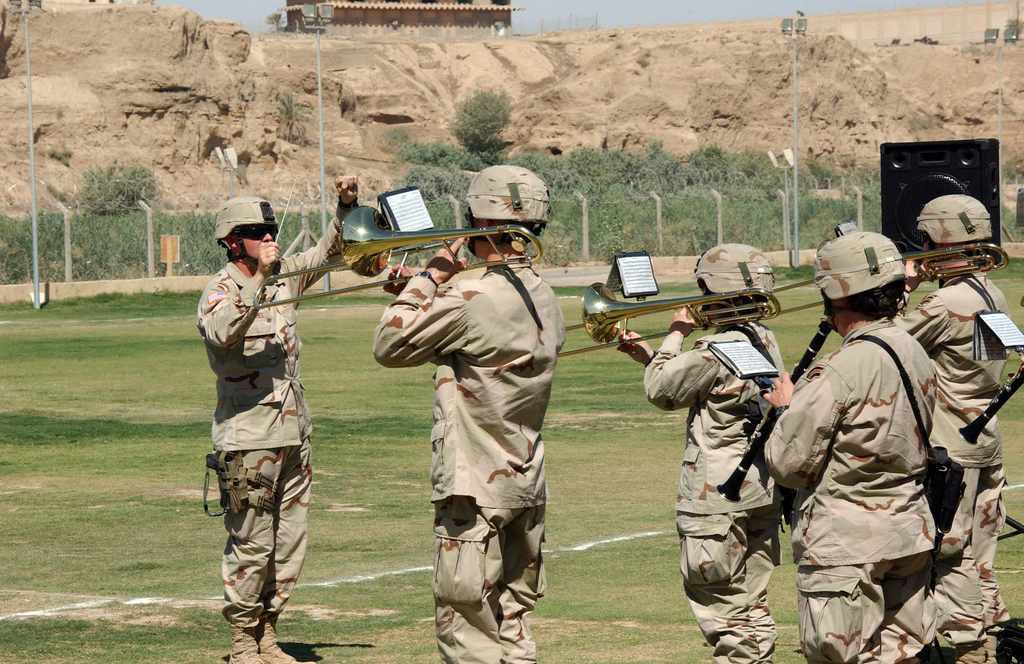
The history of the 42nd Infantry Division Band
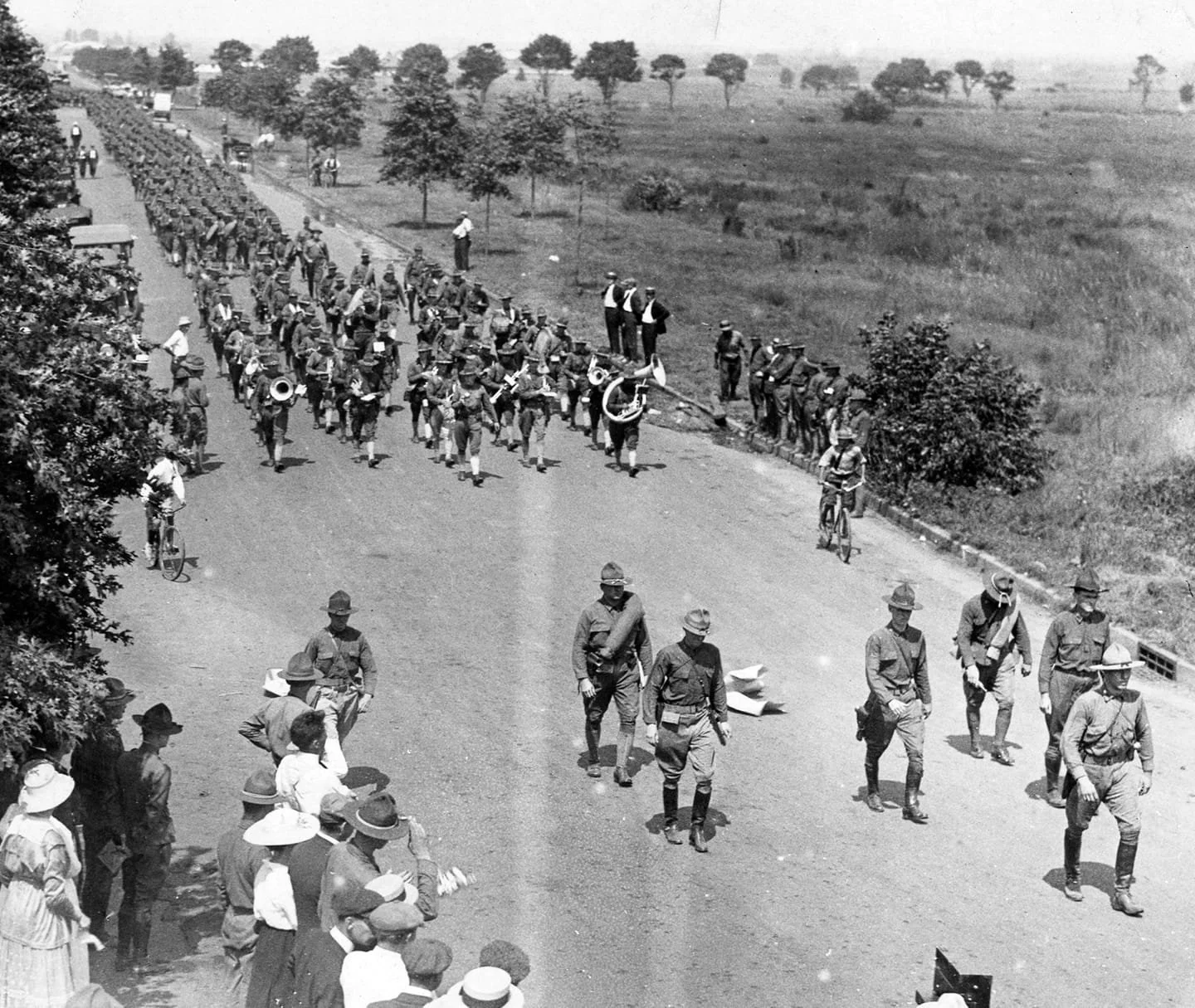
69th NY Infantry on the March to Long Island, 1917.
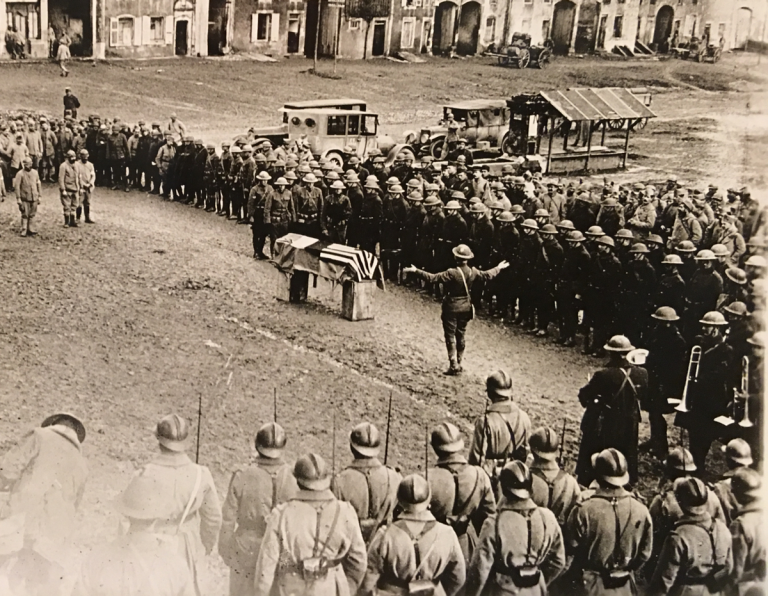
Funeral Service for Pvt. Dyer J. Bird, 166th Inf, Regt. First soldier to be killed in the 42nd Inf. Div.
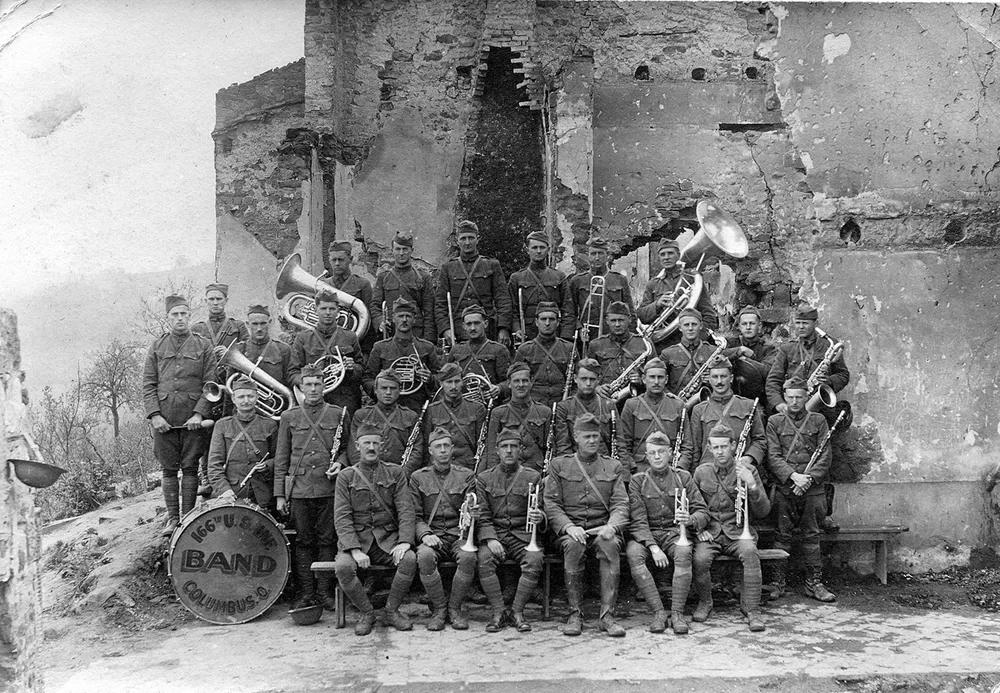
166th Inf. Regt. Band 1918.
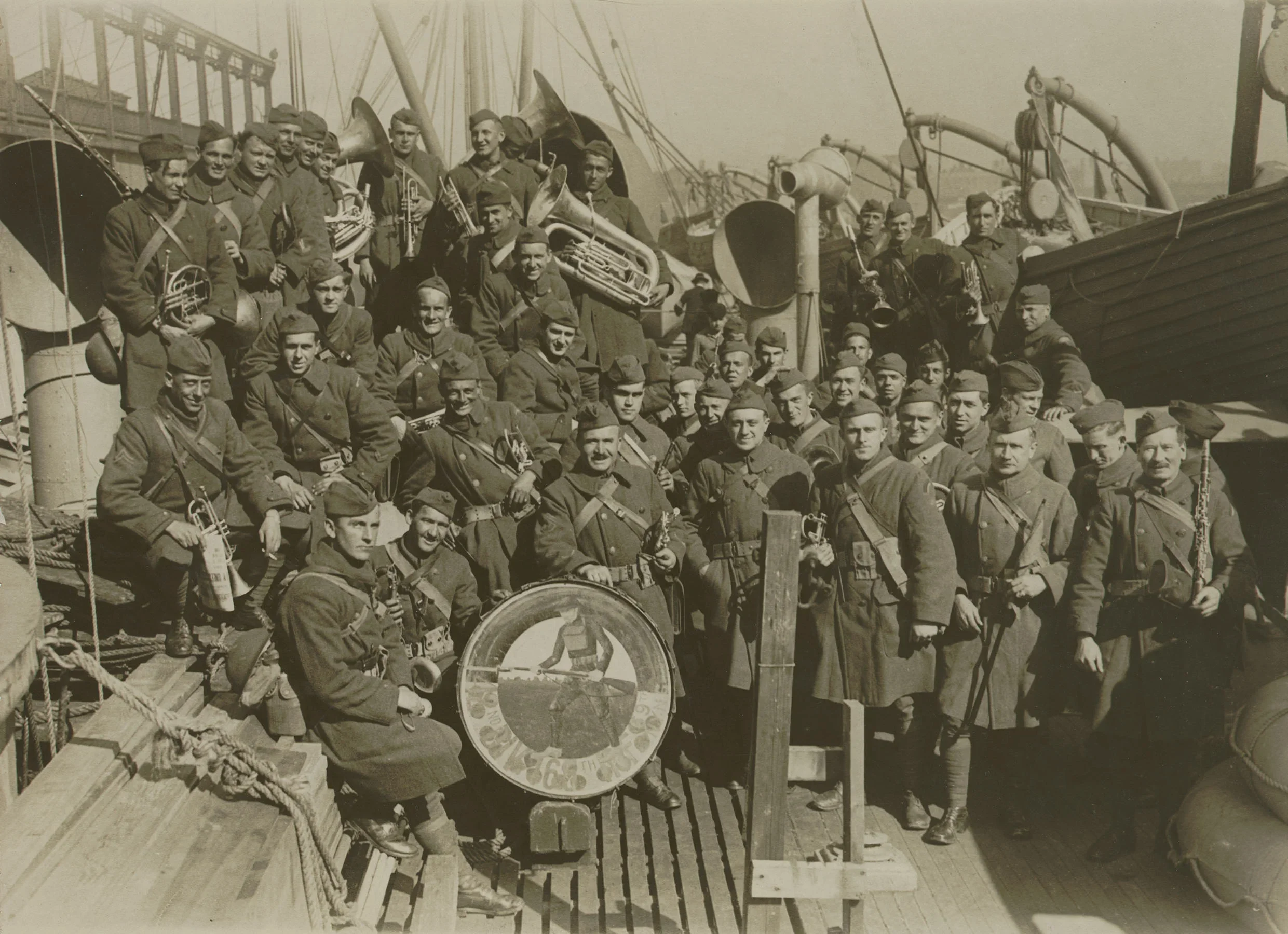
165th Inf. Regt. Band 1919 on board a troop ship bound for New York.
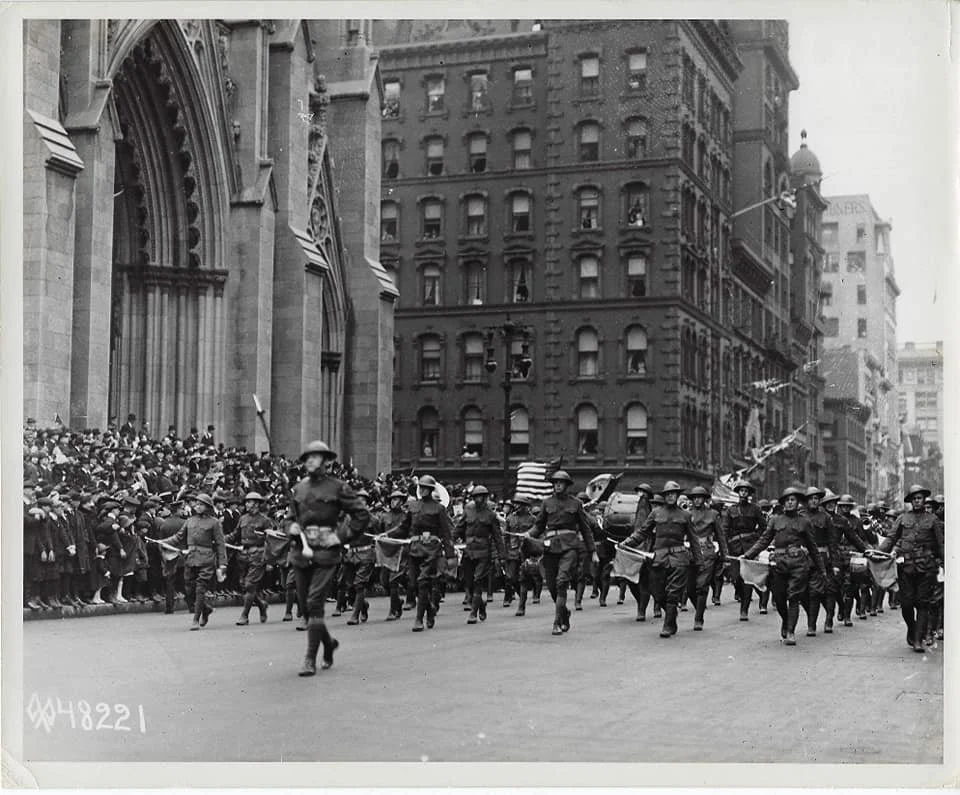
165th Inf. Regt. Band passing in front of St. Patrick’s Cathedral on its Victory Parade up 5th Ave.
28 April 1919

World War I
The 42nd Infantry Division was formed in August 1917 after a lengthy restructuring of the national Militia system into the modern National Guard system with funding from the federal government for State troops. Deriving from the mind of then Colonel Douglas MacArthur, the 42nd was composed of units not considered in the restructuring of new National Guard divisions, in which 26 states provided units for the creation of the Division. Per military composition at the time of the Division’s creation, each regiment of the Division would be allotted a band of 28 men (including a bandmaster) attached to Regiment Headquarters Company. These bands being the 165th (Formerly 69th New York), 166th (2nd Ohio), 167th (4th Alabama), and 168th (4th Iowa) Infantry Regiments. At the time no “Division Band” existed. Alongside the Bands, a Drum and Bugle Corps could also be formed out of the two buglers in each Infantry Company Headquarters. The 42nd began training at Camp Mills, Long Island in September of 1917 (now Garden City, Long Island). While in camp on Long Island the various bands performed for the troops in garrison in traditional concerts, assisted in physical training providing musical accompaniment, per “Manual of Physical Drill-United States Army” by Edmund Butts, and by fall of 1917 troops were able to purchase song books featuring lyrics to popular songs that could be used to help raise moral.
“Approximately two months spent under canvas as Camp Mills, Long Island, impatiently waiting to sail for France was to mould into a united whole these 26 different units which arrived with the natural prejudices of the different sections of the country from which they came. This was true that every sectional, racial, religious, and vocational prejudice sank far into the background before the deep bond of comradeship which being a member of the Rainbow Division came to mean and which nothing could disrupt.” – American’s All, The Rainbow Division at War (1936)
The Division began its trip to France in the beginning of October 1917 with the last remaining elements of the Division arriving in France in the first week of November 1917. Overseas, while the Division faced a battle with the Allied Expeditionary Corps over whether the 42nd would remain together or become a replacement Division, the Bands would continue their mission they started on Long Island providing musical support to their comrades. Now overseas however, the Bands also played a crucial role in supporting relations with the French people. Bands regularly would tour the local countryside bringing the universal language of music to many small communities around France. These tours not only bridged the gap between the Americans and the French but also provided a much needed distraction for the French civilians already weary from 4 years of warfare, harsh conditions, and rationing.
In February 1918, the Division would finally be called to the frontline near Domjavin, France. There, the bands of the Division would take on their secondary role during combat, of assisting the Ambulance companies as stretcher bearers. Until July 1918, bandsmen were expected to carry wounded soldiers off the battlefield to awaiting medical units for evacuation to Field Hospitals in the rear area. This job was extremely dangerous as it brought the bandsmen up close or even in the line of fire on the frontline. Bandsmen of the Rainbow would carry on this task until General “Black Jack” Pershing brought a stop to this practice. Pershing had long been an activist and aficionado of military bands. It was Pershing who established the first School of Music at Fort Jay on Governor’s Island in New York City and it was Pershing who, upon hearing the bands of the European armies fully realized the value of music, but also the sorry state of American military bands. In July 1918, by the request of Pershing, congress passed an act increasing Bands from its sparse 28-man composition to a full 48-man band as well as promoting band leaders from NCOs to Officers. Throughout the remainder of war in Europe the bands would continue their civilian tours, morale concerts for the troops when rotated off the line, and when the regiments were on the move acting as “salvage troops” when needed. (Salvage troops were responsible for following on after major combat and salvaging any equipment on the battlefield able to be repaired to returned to service.)
From February 1918 to November 1918 the 42nd was part of some of the heaviest fighting the American military would face on the Western Front against the Germans. At 11am on 11 November 1918, the armistice would come, at least temporarily ending the fighting. Shortly after the announcement of the Armistice, the 42nd would begin its new task being assigned now to the newly created Army of Occupation. The 42nd would officially step foot on German soil on December 2nd 1918 after crossing the Sauer River in the Consdorf region. The 42nd would then continue its march through Germany until reaching the Rhine River, the goal of every doughboy, tommy, and Poilu of the western allies, on the 15th of December 1918. There the 42nd would install itself at Ahrweiler, Germany as part of the Army of Occupation (3rd U.S. Army). General Pershing would praise the 42nd during its time in combat and on occupation in a letter to the Division commander Major General Clement Flagler dated 22 March 1919:
“Since the signing of the Armistice, the 42nd Division has had the honor of being one of those units composing the Army of Occupation, and I have only words of praise for the splendid conduct and demeanor during this time. I want each man to realize the part he has played in bringing glory to American Arms, and to understand both my pride and the pride of their fellows throughout the American Expeditionary Forces in their record. My good wishes accompany your on its return to the United States, and my interest will remain with its members in their future careers.
Sincerely,
John J. Pershing”
Shortly thereafter, the 42nd would once more return to France, though this time marching in a different direction, Home. Arriving in Brest, the Rainbow men found one final task ahead of them, coaling the ships to return. Something had gone awry in the preparations for sailing in which all the coal for the ship was delivered but unable to be loaded on board. And so, according to the 42nd Division history book:
“[The Division commander] sent for the Colonels and told them the situation. He told them to get their Field Officers and Captains together, explain it to them and then have them tell the men that it is up to them whether the Leviathan sailed that day or waited until the next.
With Four bands to furnish music and an unending stream of more than 12,000 soldiers eager to throw the coal into the Leviathan’s bunkers, probably no ship was ever coaled so quickly.” – American’s All, The Rainbow Division at War (1936)
The first of the 42nd set sail on 9 April 1919 with the rest of the Division leaving France on the 15th, 17th, and 18th. 18 April 1919 marked exactly 18 months since the 42nd left the United States on 18 October 1917. Upon arriving home many units of the 42nd were welcomed home with great jubilation and “ticker tape” parades in their hometowns. All these parades were lead by the bands of each respective unit, most with 3 glittering gold overseas chevrons on their sleeves representing those 18 months overseas.
By the beginning of May 1919, every unit of the 42nd had returned to their home states and on 9 May 1919 the 42nd Division Headquarters at Camp Dix, New Jersey officially demobilized, marking the end of the 42nd’s journey in the First World War.
